
User Manual
Advanced
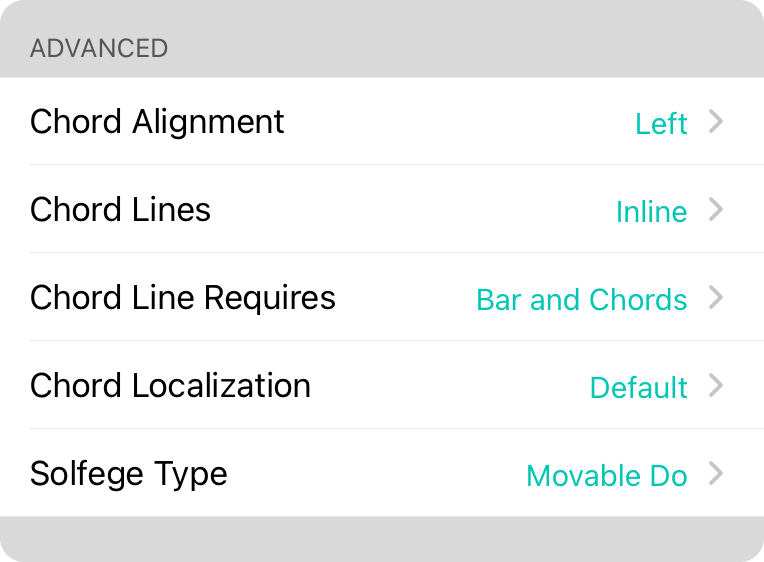
These are more advanced options that are not available within the menu but that alter how the renderer treats chords.
Chord Alignment
By default, chords are aligned so that the left edge of the chord text is placed to the left edge of the lyrics that it's associated with. You can change this to:
- Left aligns the left edge of the chord text to the left edge of the lyric. (Default)
- Center aligns the center of the chord text to the left edge of the lyric.
- Right aligns the right edge of the chord text to the left edge of the lyric.
- Character aligns the center of the chord text to the center of the first character of the lyric.
- Word aligns the center of the chord text to the center of the first word or fragment to which the chord is associated.
Chord Lines
Sometimes it's important to output chords with symbols such as vertical bars and slashes to indicate strum patterns. When OnSong encounters a line of chords containing a vertical bar or pipe character, it will automatically place chords inline with those characters. This behavior can be changed to the following parameters:
- Above displays chords above the characters as if the text were lyrics.
- Inline displays the chords on the same line as the characters. Default.
Chord Line Requires
This setting determines what is required to determine if a chord line has been encountered. Options include:
- Bar and Chords requires the presence of a vertical pipe character (bar) as well as only chords on the line. Default.
- Bar Only requires only the presence of a vertical pipe character (bar).
Chord Localization
OnSong uses alphabetic letters as a convention for defining chords. By default, OnSong understands capital letters A through G. Some regional preferences exist which vary from this convention. These include:
- Default displays chords as capital letters from A through G with flat or sharp symbols as needed. Minor chords are denoted by a lowercase "m" to the right of the chord.
- Čeština displays chords in a convention familiar with the Czech language. This displays "B" as "H" and "Bb" as "B". In addition, minor chords are denoted by lowercase "mi".
- Deutsch displays chords in a convention familiar with German-speaking people. This displays "B" as "H" and "Bb" as "B".
- Scandinavian displays chords in a convention familiar with Scandinavian-speaking people. This displays "B" as "H" and "Bb" as "Bb".
Solfege Type
When using the Solfege chord style (do, re, mi, ...) this determine how "do" aligns to the root chord of the key.
- Locked Do displays "do" as always aligning with the C note. For instance, if the song is in the key of D, the D chord displays as "re".
- Movable Do displays the "do" as the root chord of the key. For instance, if the song is in the key of D, the D chord displays as "do".